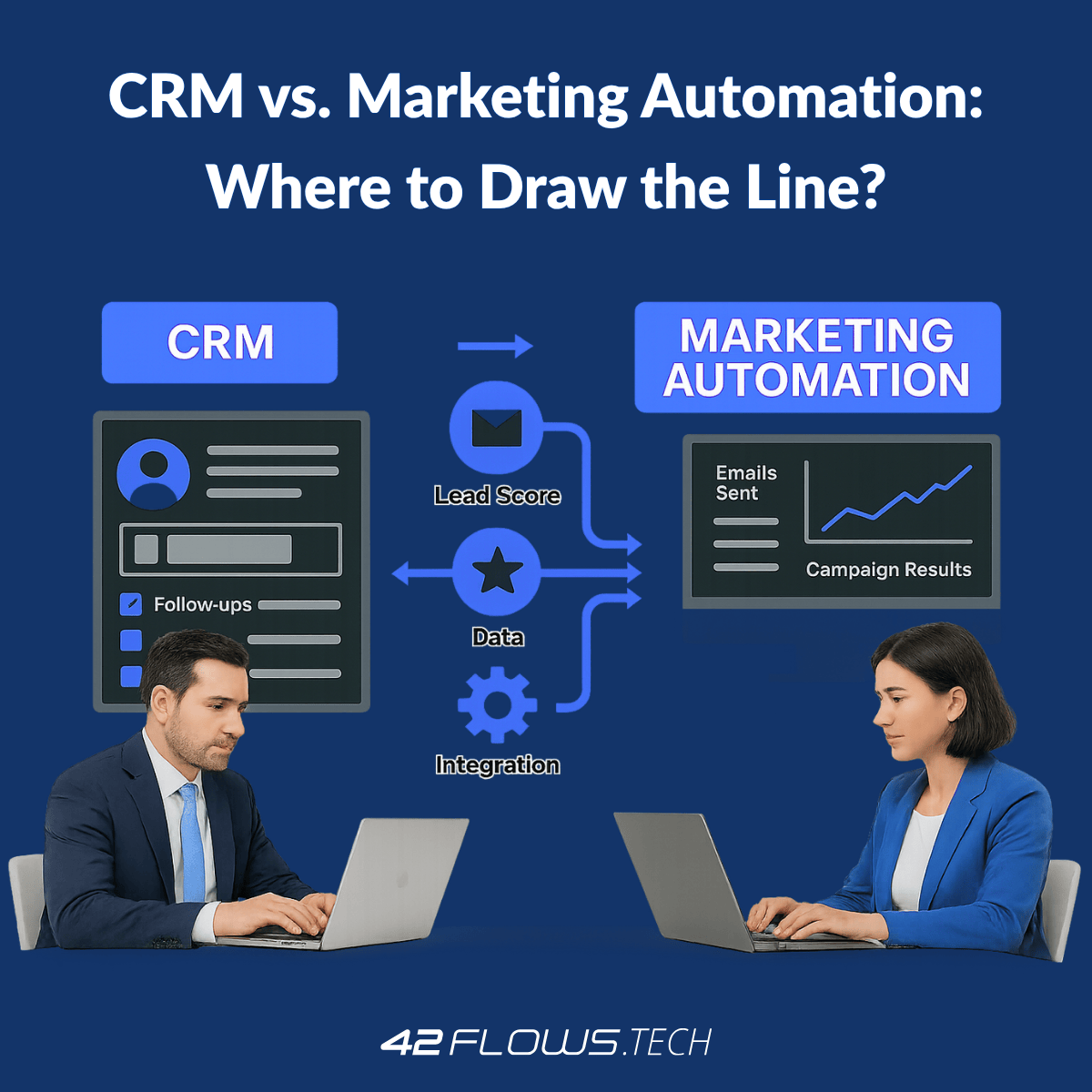

Businesses today rely on technology to streamline customer relationships and automate marketing efforts. But as companies scale, they often struggle to differentiate between Customer Relationship Management (CRM) systems and marketing automation platforms.
Many organizations believe that a CRM can handle all marketing tasks, while others assume that marketing automation can replace a CRM entirely. The truth is, these tools serve distinct but complementary roles. A well-integrated approach ensures that sales, marketing, and customer service teams work seamlessly together—improving lead conversion, customer engagement, and revenue growth.
This article explores where CRM ends and marketing automation begins, the key functions of each, and how businesses can integrate them effectively.
A Customer Relationship Management (CRM) system is designed to manage and track customer interactions throughout the entire lifecycle. It acts as the centralized hub for all customer data, including:
A CRM system is primarily sales-driven, helping businesses build relationships and move leads through the pipeline efficiently.
A marketing automation platform focuses on automating marketing tasks to nurture leads before they reach the sales team. Key functions include:
Marketing automation is focused on lead nurturing, helping marketing teams engage potential customers until they are ready to buy.
| Feature | CRM (Sales-Focused) | Marketing Automation (Lead Nurturing) |
|---|---|---|
| Primary Goal | Manage customer relationships | Automate and personalize marketing efforts |
| Users | Sales teams, customer service | Marketing teams |
| Lead Management | Tracks leads and moves them through the sales funnel | Scores and nurtures leads before handing them to sales |
| Automation | Basic follow-ups and reminders | Advanced email, SMS, and multi-channel automation |
| Data Type | Customer contact history, interactions, and sales pipeline | Engagement metrics, campaign performance, and lead scoring |
| Customer Journey | Starts when a lead is ready to engage with sales | Starts at the awareness stage and nurtures leads |
| Reporting & Analytics | Sales performance and revenue forecasting | Campaign performance and lead engagement tracking |
While both tools deal with customer interactions, CRM is more transactional, while marketing automation is engagement-driven.
Although CRM and marketing automation tools serve different purposes, they overlap in key areas:
A properly integrated system ensures that marketing teams hand off warm leads to sales at the right time, reducing manual effort and improving efficiency.
Use CRM – If your primary goal is to track leads, close deals, and manage customer relationships, a CRM is the right tool.
Use Marketing Automation – If you want to nurture leads with email sequences, score prospects based on engagement, and track marketing performance, marketing automation is essential.
Use Both – If your business wants to optimize both lead generation and sales conversions, integrating CRM and marketing automation will ensure that no potential customer falls through the cracks.
To maximize efficiency, businesses should integrate their CRM and marketing automation platforms. Here’s how:
A fast-growing fintech company struggled with poor lead conversion rates because their marketing team generated high traffic, but the sales team was not engaging with the most promising leads.
Solution:
Results:
This case study highlights how CRM and marketing automation together drive stronger business outcomes.
CRM and marketing automation are not interchangeable—they serve distinct roles but work best when integrated strategically. A CRM helps sales teams track and manage relationships, while marketing automation nurtures leads and drives engagement before sales steps in.
Businesses that align both tools gain higher lead conversion rates, improved efficiency, and a seamless customer experience.
At 42Flows, we specialize in building customized CRM solutions that integrate with advanced marketing automation platforms to create high-performance customer engagement ecosystems.
Let’s talk. Just enter your details and we will reply within 24 hours.


 Maksym Popov