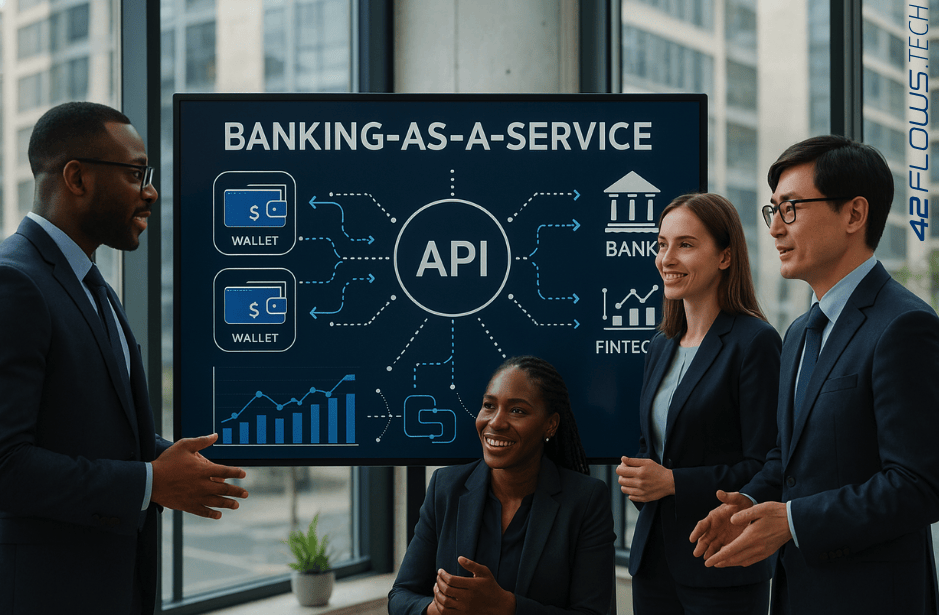

Banking-as-a-Service (BaaS) is transforming the financial industry by enabling non-bank companies to offer banking services without having to build their own infrastructure. From fintech startups to e-commerce platforms, businesses are embedding financial services directly into their products, leveraging BaaS providers to deliver seamless payment, lending, and banking solutions. But what does this shift mean for banks and fintechs? Let’s explore the impact of BaaS on the future of finance.
BaaS allows non-banking companies to integrate banking capabilities via APIs provided by licensed banks or financial institutions. This model enables businesses to:
✅ New Revenue Opportunities – Instead of competing with fintechs, banks can partner with them by providing infrastructure.
✅ Scalability – Banks can expand their reach without needing to acquire new retail customers.
✅ Regulatory Challenges – Banks offering BaaS must ensure compliance with anti-money laundering (AML) and Know Your Customer (KYC) regulations.
✅ Faster Market Entry – Startups can launch banking products without the cost and complexity of building from scratch.
✅ Enhanced Customer Experience – Users stay within a single platform for all their financial needs.
✅ Regulatory Dependencies – Fintechs still rely on BaaS providers to ensure compliance and licensing.
Neobanks like Revolut and Chime use BaaS providers to offer banking services without holding full banking licenses.
Amazon and Shopify integrate BaaS solutions to provide instant payments and merchant financing.
Uber and Lyft offer driver-focused debit cards and instant payout services through BaaS partners.
Accounting software companies like QuickBooks embed payments and invoicing solutions powered by BaaS providers.
🔹 Expansion into New Sectors – More industries (e.g., healthcare, real estate) will integrate financial services.
🔹 AI-Driven Banking – AI will enhance fraud detection, credit scoring, and customer personalization in BaaS platforms.
🔹 Decentralized Finance (DeFi) and BaaS Convergence – Blockchain-based financial services could integrate into BaaS ecosystems.
Banking-as-a-Service is reshaping how financial services are delivered, benefiting both fintech disruptors and traditional banks. As embedded finance continues to grow, BaaS will play a crucial role in enabling seamless financial experiences across industries.
Want to explore BaaS solutions for your business? Contact us today! Email us at success@51.20.208.231, and we will help you implement an effective strategy
Let’s talk. Just enter your details and we will reply within 24 hours.


 Maksym Popov